


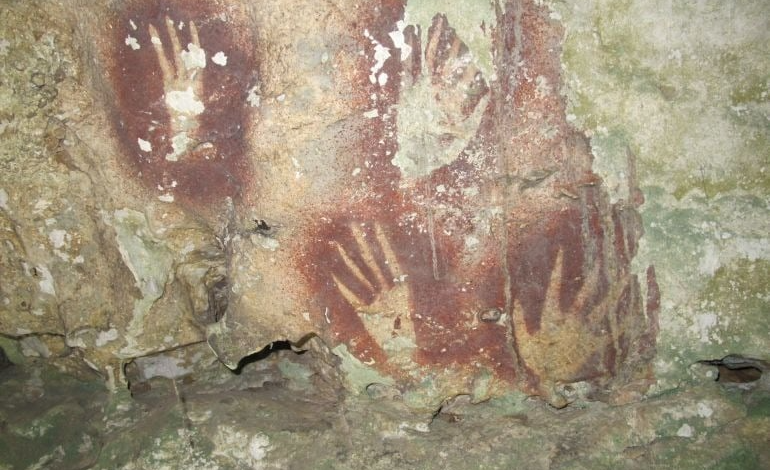

Scientists have discovered what may be the oldest known rock art in the world inside a cave in Indonesia.
The artwork is a human handprint found deep inside a limestone cave on Muna Island. Researchers say the handprint is nearly 68,000 years old, giving us a fascinating glimpse into the lives of early humans.
A simple handprint with a big story
The artwork was made by placing a hand on the cave wall and spraying reddish brown paint around it. When the hand was removed, the shape of the hand remained on the wall.
Several handprints were found in the cave using this technique.
Scientists say the oldest hand stencil was created at least 67,800 years ago.
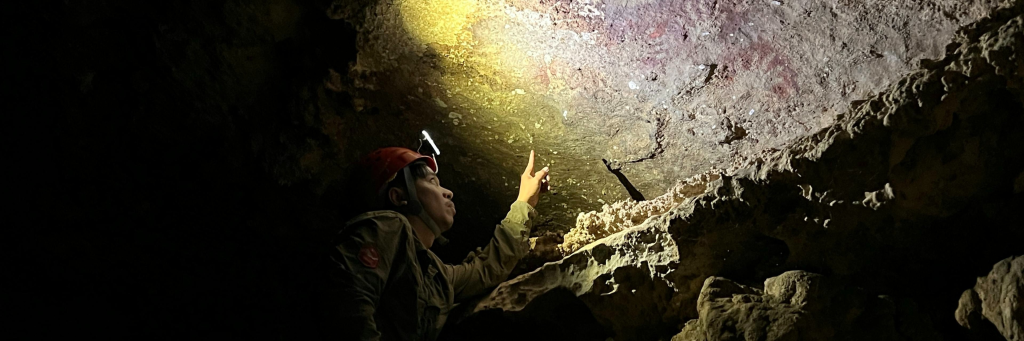
The world’s oldest known artwork found in a cave in Indonesia.
How scientists discovered its age
Indonesian archaeologist Dr. Adhi Agus Oktaviana and his research team studied mineral layers that formed on top of the paint over thousands of years.
By analysing these layers, they were able to estimate how old the artwork is.
Their research was published in the science journal Nature in January 2026.
Older than famous cave art in Europe
Before this discovery, some of the oldest known cave art had been found in France in 1994.
The Indonesian handprint is about 30,000 years older than that artwork.
This means humans were making creative images much earlier than scientists previously believed.
A creative touch from early humans
The handprint also has an unusual detail.
One of the fingers appears to have been altered to look sharp and claw like, showing that early humans may have been experimenting with creative ideas and imagination.
According to researchers, this suggests that people living during the Late Pleistocene period were already capable of complex thinking.
A cave used for thousands of years
Scientists believe the cave continued to be used by people for many generations.
Later artists added other drawings, including pictures of pigs, boats and human like figures.
These drawings help scientists understand how early people lived and what was important to them.
Clues about early human journeys
The discovery may also help explain how early humans travelled across the world.
Muna Island lies along a possible migration route from Southeast Asia toward Australia.
Evidence shows that humans reached Australia around 65,000 years ago, and islands like Muna may have been important stopping points along the journey.
Photo: The handprint on the far left is believed to be the world’s oldest rock art, Photo Credits: Oktaviana et.al/ Nature.com