


Two fossilised whale skeletons believed to be around 10 million years old have been discovered on a beach in Portugal.
The fossils were found near Galé Fontainhas beach in the municipality of Grândola after strong storms moved the sand and exposed ancient remains.
Storms reveal ancient fossils
Heavy storms uncovered a large section of rock more than 100 metres long along the coast.
Scientists examining the rocks discovered several fossils, including parts of two ancient whale skeletons.
Experts say the rocks belong to the Miocene period, about 10 million years ago, when the area was part of a shallow sea.
A complex excavation
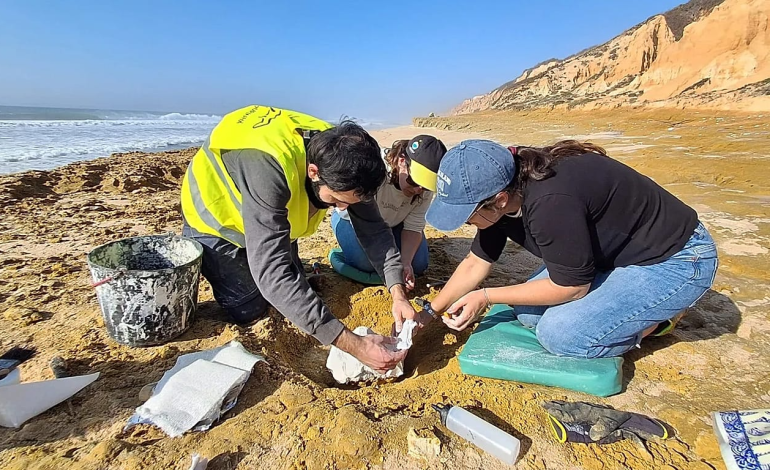
After the discovery, the municipality asked the Lourinhã Museum for help because it has experience in extracting large fossils.
Scientists from the Lourinhã Museum, the Dom Luiz Institute at the University of Lisbon, and the National Museum of Natural History and Science worked together on the excavation.
The work was challenging because the site could only be accessed when the tide was low.

One of the fossil whale specimens extracted from the cliffs located to the north of Galé Beach – Fontainhas Município de Grândola
One of the most complete fossil whales in Europe
Researchers say the two whale skeletons are among the most complete fossil whales from the Miocene period discovered in Portugal and among the most complete in Europe.
One skeleton includes a skull, two nearly complete jawbones, and several ribs and vertebrae.
The second skeleton contains an almost complete skull, parts of the jawbones, ribs, vertebrae, and possible bones from the forelimbs and shoulders.
Many other prehistoric sea animals found
The rock layer also contains fossils from many other marine animals.
Scientists identified remains of dolphins, turtles, sharks, bony fish, and possibly birds.
They also found fossils of small sea creatures such as bivalves and barnacles.
Learning about ancient oceans
Experts believe the whales may belong to the Cetotheriidae family, a group of small to medium sized whales that lived along the Portuguese coast about 10 million years ago.
Studying these fossils may help scientists understand how ancient whales lived and what the ocean environment was like millions of years ago.
What happens next
The fossils will be taken to the Lourinhã Museum laboratory, where scientists will carefully clean, preserve, and study them.
Researchers hope the discovery will provide new information about prehistoric marine life and help share this important scientific find with the public.
Photo Credits: Município de Grândola