



Scientists have discovered new clues about some of Earth’s earliest fish, helping them understand how animals eventually moved from water onto land.
The discoveries come from fossils found in Australia and China. These fossils are more than 400 million years old and belong to ancient fish called lungfish.
Why lungfish are important
Lungfish are special because they are among the closest living relatives of animals that later moved onto land.
These land animals are called tetrapods, which are vertebrates with limbs. This group includes animals such as frogs, reptiles, birds, mammals and even humans.
Studying ancient lungfish helps scientists understand how early vertebrates evolved before life began spreading onto land.
Fossils discovered in Australia
One important fossil was found in the Gogo Formation in Western Australia.
The Gogo fossil site is famous for its well preserved fossils from the Devonian period, which took place more than 400 million years ago.
Scientists from Flinders University studied a mysterious fossil using advanced imaging technology such as CT scanning.
These scans allowed researchers to create detailed digital images of the fossil’s skull and brain cavity.
The fossil came from an ancient reef system in the Kimberley region that scientists sometimes describe as Australia’s first “Great Barrier Reef” from the Devonian era.
Technology helps reveal new details
Using CT scans and other imaging tools, scientists discovered that earlier researchers may have been looking at the fossil incorrectly.
The fossil had likely been viewed upside down and backwards in earlier studies.
The new images also revealed details of the fish’s inner ear, helping scientists compare it with other lungfish fossils found in the same region.
Ancient fish discovered in China
Another important discovery came from fossils found in Yunnan, China.
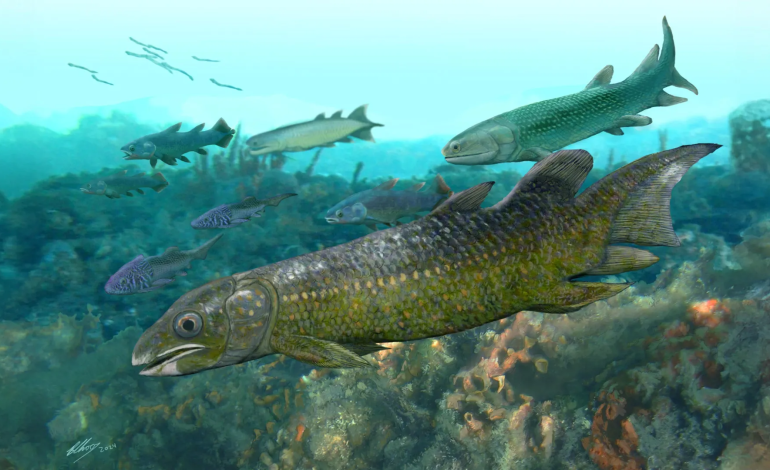
Scientists reconstructed the skull of an ancient lungfish species called Paleolophus yunnanensis, which lived about 410 million years ago.
The fossil was studied by scientists from Flinders University and the Chinese Academy of Sciences.
What the fossil shows
The skull of Paleolophus helps scientists understand how lungfish were evolving during the Devonian period.
This was a time when lungfish were beginning to develop new feeding adaptations and spreading into different environments.
The fossil also shows similarities to other ancient fish species found in places such as Wyoming in the United States and Australia.
Understanding the story of life
Today, some species of lungfish still exist, including the Australian lungfish found in Queensland.
Because these fish are closely related to the ancestors of land animals, they provide important clues about how vertebrates slowly evolved from life in water to life on land hundreds of millions of years ago.
Photo: Illustration of Paleolophus – a lungfish that swam in the South Chinese seas 410 million years ago, Photo Credits: Brian Choo (Flinders University)